
 (573) 754-2482
  Open 7am–6pm Mon–Fri, 7am–3pm Sat
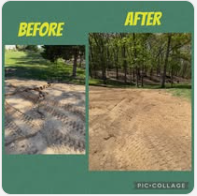
French Drain vs. Regrading: Which Fixes Your Wet Yard?
I’m Brandon Bange. When somebody’s yard won’t drain, they usually come to me already convinced they need a French drain — they saw one on YouTube and now that’s the answer. Sometimes they’re right. Plenty of times a regrade fixes it for a lot less money. Here’s how I actually decide, so you can think it through before I even show up.
What’s the difference between a French drain and regrading?
Regrading means reshaping the surface of your yard so it slopes away from the house and runs water downhill to a lower spot. No pipe, no gravel trench — just moving dirt so gravity does the work.
A French drain is a gravel-filled trench with a perforated pipe in the bottom. It catches water underground and carries it out to the street, a ditch, or a lower outlet. You use it when the water has nowhere to run on the surface.
Both are about the same goal: get the water away from your foundation. They just go about it differently.
When does regrading fix it?
Regrading is the answer when you’ve got somewhere lower for the water to go. If your yard slopes the wrong way toward the house, or there’s a dip holding water but the lot drops off past it, I can re-cut the grade so the water runs out on its own. It’s usually the cheaper fix because there’s no pipe and no gravel to buy and haul.
This is common on older lots in places like Wentzville where the grade has slowly settled the wrong direction over the years. The dirt’s just tilted wrong — straighten it out and the water leaves.
When do you actually need a French drain?
A French drain earns its keep when the yard’s flat with nowhere to run, or the water’s trapped in a low spot surrounded by higher ground. On the dead-flat subdivision lots over in St. Peters, there’s just not enough fall for a regrade to do anything — the water sits because gravity’s got no help. That’s textbook French drain territory: catch it underground and pipe it out.
You also lean toward a drain when the water’s pooling tight against the foundation and you need to intercept it before it gets there.
Can I just do both?
Plenty of yards get both, and that’s not me upselling you — sometimes it’s genuinely the right call. I might regrade the surface to handle the sheet water and drop in a drain to catch the trapped spot near the house. The point is matching the fix to the problem, not picking one because it sounds fancier.
Which one is cheaper?
Regrading usually comes in lower because it’s dirt work, not dirt work plus pipe, gravel, and a longer dig. But “cheaper” only matters if it actually fixes the problem — a regrade on a flat lot with nowhere to drain is money down the hole. I’d rather quote you the thing that works than the thing that’s cheapest on paper.
What I’d do on your place
I come walk it, preferably after a rain so I can see where the water sits and which way it wants to move. I check how much fall you’ve got, where the low spots are, and how close the water gets to the house. Then I tell you straight: regrade, French drain, or both — with a real number, not a vague “it depends.” I don’t push the bigger job.
{{CASE_STUDY_NEEDS_BRANDON}}
Tired of guessing? Book a bid and I’ll tell you which fix your yard needs. Every call gets answered, day or night.